Two decades after pulling off one of the most romantic and baffling disappearing acts in cinematic history, Edward Norton and Paul Giamatti have returned to the fog-drenched, cobblestone streets of early 20th-century Europe in The Illusionist 2: Shadows of the Empire. Releasing to feverish anticipation in 2026, the sequel abandons the romantic heist framework of its predecessor, plunging audiences instead into a high-stakes espionage thriller where stage magic is weaponized for political assassination. Expanding its atmospheric world exponentially, the film brings back Jessica Biel and adds Eddie Marsan to a narrative that aggressively pushes the boundaries of perception, science, and the looming shadow of global war.
The Cost of a Quiet Life
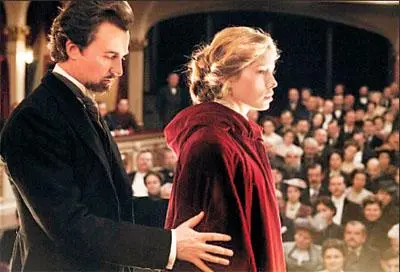
Following the breathtaking events of the original film, Eisenheim (Norton) and Sophie, Duchess von Teschen (Biel), successfully escaped the iron grip of the Austro-Hungarian Empire. The sequel finds them living a deeply secluded, quiet existence in a remote mountain village, their high-profile identities heavily concealed from the world. Biel brings a grounded, weary maturity to Sophie, portraying a woman who traded a crown for absolute freedom, only to find that the ghosts of the imperial court are not so easily banished. Their idyllic refuge is painstakingly constructed, but the fragile peace they have built is violently torn apart by chilling news filtering in from the continent.
A sinister new figure has emerged on the European stage, wielding inexplicable, seemingly supernatural abilities. Unlike Eisenheim, who used his mastery of illusion to entertain and eventually liberate himself, this unknown adversary uses dark, terrifying stagecraft to execute impossible political assassinations. High-ranking generals are murdered in locked rooms; key diplomats vanish in plain sight during heavily guarded crowded galas. The continent teeters dangerously on the brink of absolute war, driven by the paranoia of an unseen, unstoppable assassin who leaves no physical evidence behind. The film meticulously establishes this escalating dread, framing the illusions not as mere parlor tricks, but as calculated acts of profound terrorism that defy all scientific explanation.
A Bitter Reunion
At the heart of the sequel’s dramatic tension is the return of Chief Inspector Uhl, played with magnificent, weary desperation by Paul Giamatti. Once a rising, ambitious star in the imperial police force, Uhl was disgraced and permanently dismissed following his failure to capture Eisenheim and the subsequent scandalous death of Crown Prince Leopold. Now a haunted, marginalized detective drinking his way through the gutters of Vienna, Uhl is forcibly recruited by the desperate remnants of the imperial intelligence network. The crown recognizes that traditional policing and military force are entirely useless against a killer who manipulates reality itself. Uhl is tasked with an impossible, deeply humiliating mission: track down the only man capable of unraveling these deadly deceptions.
The reunion between Uhl and Eisenheim forms the emotional bedrock of Shadows of the Empire. Giamatti and Norton seamlessly slip back into their complex, highly adversarial chemistry. There is no warm embrace or forgiveness; their alliance is born of pure, unadulterated necessity. Uhl represents the corrupt, decaying empire that Eisenheim fled, while Eisenheim is the living embodiment of the failure that ruined Uhl’s life. Yet, as they are drawn into a labyrinthine plot orchestrated by a phantom, they are forced into a reluctant, highly volatile partnership. Norton’s performance evolves brilliantly; his Eisenheim is no longer a lovestruck romantic, but a wary, battle-hardened master of his craft, forced to step back into a spotlight he deliberately destroyed.
The Architecture of Deception
The primary antagonist of the film is a masterstroke of casting and writing, with Eddie Marsan stepping into the role of a lethal shadow-broker whose understanding of grand illusion rivals, and perhaps exceeds, that of Eisenheim. The adversary’s methods blur the increasingly thin lines between emerging industrial-era science, advanced psychological manipulation, and outright dark magic. The script delves deep into the terrifying mechanics of deception, exploring how mass hysteria, optical engineering, and chemical hallucinogens can be combined to alter human perception on a geopolitical scale.
What makes the conflict so deeply unsettling is the realization that this new enemy knows Eisenheim’s absolute deepest secrets. Every technique, every mechanical blueprint, and every psychological blind spot that the master illusionist possesses has been weaponized against him. The film crafts a perilous battle of wits and sleight of hand, where the audience is constantly forced to question the fundamental reality of what they are witnessing onscreen. Is it a trick of the light, a complex mechanical apparatus hidden in the floorboards, or has the film finally crossed the threshold into the truly supernatural? The narrative keeps these questions suspended in mid-air, maintaining a relentless, suffocating tension throughout the second act.
A Masterclass in Visual Spectacle
Cinematographically, Shadows of the Empire is a breathtaking achievement. The production design recreates the decaying, paranoid opulence of the Austro-Hungarian Empire with meticulous, historical dread. The warm, sepia-toned memories of the original film clash violently with the stark, cold realities of a world standing on the immediate precipice of World War I. The illusions themselves are captured with a visceral, practical authenticity, relying heavily on brilliant in-camera effects, lighting tricks, and classic stagecraft rather than overwhelming digital manipulation. This commitment to practical visual mastery grounds the high-stakes intrigue in a tactile reality, making the impossible assassinations feel genuinely terrifying.
As the film races toward its breathless climax, the scope of the deception widens into a dangerous new spectacle that threatens to consume the entire cast. The grand finale is an intricate, multi-layered puzzle box of a sequence, demanding absolute attention from the viewer as the final traps are sprung. It is no longer merely about exposing the killer, but about dismantling a geopolitical machine designed to burn Europe to the ground. The Illusionist 2: Shadows of the Empire ultimately proves that while disappearing into the ether may require absolute genius, surviving the grand finale requires something far more dangerous. It is a stunning, meticulously crafted thriller that boldly redefines its predecessor, cementing Eisenheim not just as a master of illusion, but as an unwilling savior in a world completely blinded by its own dark magic.